4.5.1Do you know your roots?
Newton's Method
Based on the fragment of a function shown at right, make a reasonable estimate for the root (

Locate the graph of
Determine the integer closest to the root (
-intercept) of and label it . Use a tangent line at the point
to make another approximation of the root. Label this point . Which point is a better approximation? Repeat the process again: use a tangent line at the point
to make another approximation of the root. Label this point . Describe your observations from this process.
.png)
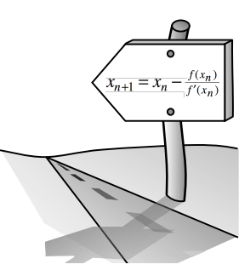
The process for determining the root of a function that you used in problem 4-169 is called Newton’s Method. Newton’s Method starts with an
If
and , calculate , and . Explain what happens to
as increases.

Newton's Method for Approximating Roots
Newton’s Method uses an iterative process to approximate a root (
The
Solve for

Therefore, each new approximation,
Suppose you want to approximate

Sketch
Use the Intermediate Value Theorem to show there is a root between
and . Let
. Use Newton’s Method to calculate . How close is
to the actual root of ? Calculate the error.
Use the equation for Newton’s Method in the Math Notes box in this lesson to approximate the root of
Examine the equation
Write a complete description about what the integral will compute. In other words, in the context of the problem, what is accumulated? Use correct units and be sure to mention the meaning of the bounds in your description. Homework Help ✎
Rewrite each of the following expressions using a single trigonometric function. You may wish to review your trigonometric identities from Chapter 1. Homework Help ✎
Solve for
Use the definition of a derivative as a limit to determine
Using your graphing calculator, determine all relative maxima and minima points of inflection, and discontinuities of the curve


